
Fire all of them !

DSC_0219 (2)

“The old me would have fired the whole team and started over.”

That’s a quote from Joe, a new GM who inherited his leadership team through a merger.  He and his team were charged with turning around a failing global business unit, and it wasn’t going well.  Sure, many of them were doing OK with their country assignments, but as a whole, it was anything but a team effort.  Joe was frustrated and exhausted trying to hold everything together.

This blog isn’t, however, about how to build teams.  That’s for another day.  It is about what happens when you pick an extreme and act on it fully.  Sure, Joe could start over with a hand picked team.   The down side of that decision is that Joe remains a constant.  Whatever he was  (or was not) bringing to the team, as their leader, would still be the same.

When we make either/or choices, it’s usually to relieve our discomfort or pain.  By the nature of an extreme, it’s all about “me.”  Thus, we don’t have an opportunity to change, learn or grow.  Unfortunately, we often end up creating the same problems for ourselves in the future.

So, what’s the alternative?  If we’re not choosing either/or, what do we do?   Practice duality.  We not only look at both/and, we also consider the greater good, larger purpose.  For Joe, that means looking at his personal needs and each team member’s and the team’s as a whole and the organization’s and the customer’s.  It means considering skills and challenges in addition to needs and comfort (the easy way).  It means no longer bearing the load all yourself (victim) and reaching out to co-create solutions together.  And, yes, it means Joe looking at how he can change, learn and grow in the process.

What either/or choices are you facing in your work or life?  How might you broaden your choices to include others and consider the greater good?  What collaborative solutions might you engage in?  How can you get the best of both sides of the either/or plus more?
Either/Or . . . Both/And

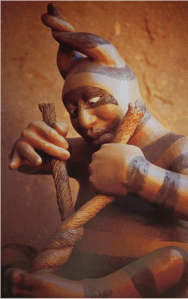
Rope Clown

I became curious about the concept of duality in the mid 1990’s and have been building A Solutions Model ever since. It seems only fitting that I start from this topic in my inaugural blog. It struck me that living in an either/or world means we’ll always be focusing on differences which typically results in judgement.  Depending on your perspective (the side you take) one way is usually preferable and the other less desirable or downright awful. Think about differences like:  Life/death, Cooperate/Compete, Intuitive/Analytical, Chaos/Stability, Independent/Dependent, Theoretical/Practical, Masculine/Feminine, Proud/Humble, Complexity/Simplicity and so on.  We also judge based on philosophies, religion, race, gender, etc.

There must be a better way.  If not, what’s the impact on leaders, teams and organizations?  Will it always be win/lose, my way/your way, zero/sum? What does it take to move from conceding to cooperating to collaborating where we all win?  And, does it really matter?  What I see is that, if we don’t find a way to balance the two sides, better yet to integrate them (take the best of both), we’ll keep fighting wars in the name of “my” religion/country/way, ruining the environment, harming relationships and working less effectively.  There IS a better way.

Roxanne Swentzell is a potter and writer from New Mexico’s Santa Clara Pueblo.  Many of her pieces deal with the concept of duality.  One fascinating sculpture is “Rope Clown.”  She describes him as having “2 strands of rope he’s twisting together.  The amount of pull on both gives the rope its effectiveness, making it stronger than a single strand.  Rope Clown is about strength and balance.  Equal understanding must be given to matters of life/death, darkness/light, female/male, spirit/matter and so on.  Opposites can be destructive unless they are put in balance where they strengthen each other.  All creation is in his hands.”

Duality is represented in A Solution Model as “On-the-Line” (OtL).  It is a place where differences can co-exist as long as there are plenty of resources or individual needs don’t conflict with others’ goals.  If you take a little, I have to give some and visa versa.  In the best circumstances, we cooperate.  In the worst, we compete or conflict.  And, there is a cost to the organization, the business unit or function, the team and each individual involved.  Someone always loses.

Watch for future blogs to see what is Below-the-Line and Above-the-Line where collaboration transforms relationships, teams and organizations.

“in divinity, opposites are always reconciled”  Walter Miller, Jr.  What’s your experience with duality?